Tuesday, July 11, 2006
Rethinking the war on terror
During our recent trip to New York City with our grandchildren, we visited some of the usual tourist attractions. Our eight year old granddaughter had advised us that it was her dream to visit the Statue of Liberty, so the Circle Line ferry to Liberty and Ellis Islands was on the schedule. It also seemed to be on everybody else’s schedule as well as the lines snaked all the way through Battery Park. One of the reasons for the long lines was the extraordinarily tight security that was in place. The very sensitive metal detectors and searches that took place were even more stringent than those at most airports and required an enormous number of security personnel to accomplish. (Perhaps this was all necessary as some terrorist might want to fly the ferry into a building) If Usama Bin Laden and his people can see the enormous changes that they have brought about in the U.S. and realize the enormous unproductive use of resources that their actions have engendered, they must be very happy. Currently we are spending $720b a year or 25% of the federal budget in defense, security and intelligence. Compare this to the $14.5b we spend on diplomacy and the $64b we spend on education at the federal level. I wonder who is winning the “war on terror” and what is the “war on terror”? Shortly after the events of 9/11, President Bush declared a “global war on terror”. (I thought only Congress could declare war, but I won’t go there.) I thought at the time that this was probably not a useful way of framing the issue. He probably should have declared war on Al Quaida as terror is not an enemy, but a tactic used by politically motivated groups to achieve their objectives. To paraphrase Dr. Martin Luther King – violence is the voice of the voiceless. When we lump ETA (the Basque separatist group), the IRA, Hamas, and Al Quaida together as terrorists, we miss their differing agendas and try to impose a one size fits all solution. Why do we do it? Well, the military-industrial complex likes it because it is a war you can never lose, but also a war you can never win. As long as we are engaged in a never ending “war on terror” we can justify huge defense expenditures and massive weapons procurement programs. Comparisons are often made between the situation in Iraq and the Vietnam War. I am not sure that comparison works, but it may work with the “war on terror”. It is a war for which we have no defined strategic objective; we don’t even know who the enemy is. We are reduced to defining progress in terms of body counts and terror cells broken up. Usama Bin Laden, on the other hand, does have a strategic objective. He wants to return to the Islamic Caliphate that existed prior to WW I. He will use whatever tactics he thinks will be effective in achieving that strategic objective, including terror. For that reason he may well win. The guy with the biggest gun doesn’t always win in an asymmetrical war. (For more than you wanted to know on this subject from people who are much smarter than I am click here)


Wednesday, July 05, 2006
The absurd and the tragic
So much of what is happening in the Middle East is so absurd that if it were not so tragic it would be funny. One thing that amazed me as we traveled through the West Bank was the dark sense of humor that our Palestinian friends have maintained through all of their tragedy. Maybe humor is the way out of this impasse. Do we need to laugh at what is going on? Some seem to be able to do that. When the Israeli Defense Forces bulldozed two toilets that had been built for homeless Palestinians by American relief agencies, I couldn’t understand the military importance of this venture. However, a Palestinian blogger opined that perhaps the reason for the destruction was that the noises coming from the toilets sounded like bombs going off. Recently the Israeli Air Force bombed an electrical power plant in Gaza. The military significance of this adventure was also not clear to me as all it did was make life miserable for 1.4 mm Palestinians in the sweltering Middle East summer. In this land of the absurd it has come to light that the plant was owned by a U.S. company and was insured by an agency of the U.S. government. (If you think that this is too absurd to be true, click here) So it appears that Americans will pay to build the plant, pay to blow it up, and then pay to rebuild it. At the risk of repeating myself, isn’t there a better way to waste taxpayer money? I am really trying to see the humor in all this. As one of my friends pointed out that rather than get angry, a better way to change our government’s policies is just to laugh at them and make them the butt of our jokes. Ha ha ha.
Wednesday, June 28, 2006
American Girl - A marketing case study
I recently visited New York City (The Big Apple) with my grandchildren and their mother. One of the “adventures” on the schedule was a visit to American Girl Place, a Mecca for young girls ages 5 to 12. To me this store on Park Avenue is the epitome of great marketing. In the best Harvard Business School tradition, American Girl has identified the “decision making unit”, young girls, their mothers and grandmothers, ( It is not clear to me who the decision maker is) and has tailored a product and marketing message to each of them. For the girls are the dolls with matching clothes for the girls; for the mothers and grandmothers are the educational books and multicultural components. The fact that there is no sports bar for bored old grandfathers probably says something about our role in the process. This program certainly seems to be a marketing success. As our eight year old grand daughter said “Grandma, I think every girl in NYC will own an American Girl doll”. This may be a bit of a stretch as the dolls are $100 and it’s hard to get out without $100 of accessories. She may, nonetheless, be correct as it seemed as though every other girl on the street was carrying an American Girl doll. As I thought about the success of this marketing program, I was motivated to compare it to the effort of the US government to market our foreign policy in other parts of the world. We have budgeted $600 mm per year and assigned Karen Hughes, one of President Bush’s most trusted advisors to implement a public diplomacy initiative. Our government seems to have realized that encouraging democracy in countries where a large majority of the population does not like US policies is likely to result in the election of a government that is opposed to the US. We have seen the beginnings of this in the election of Hamas in the Palestinian Territories and the strong showing by the Muslim Brotherhood in Egypt. The US government, however, seems to have missed the most important part of an effective marketing program: developing a product that meets the needs and desires of the targeted customers. I don’t think that we can sell unconditional support for Israel and their policies and actions to the “Arab street”. Palestinians who have lived under occupation for 40 years will probably not buy an invasion and occupation of Iraq. Emerging democracies will not like a country who says that it supports democracy, but then tries to overthrow elected governments that it does not like (Consider Palestine and Venezuela). As a recent panel at the Princeton University Woodrow Wilson School on U.S. Public Public Diplomacy toward The Arab-Muslim World concluded - "It's the policy stupid". I am not sure this $600mm is well spent. If you build a product that nobody wants, the best marketing program in the world will not sell it. As an Israeli blogger said in discussing the destruction by the Israeli army of toilets built by American Christian groups for Palestinians whose homes had been demolished: “Isn’t there a better way to waste taxpayer money?”.
Current Affairs
Current Affairs
Tuesday, June 20, 2006
A place of hope
Marcia recently wrote a piece for a book of essays on the lives of everyday Palestinians being compiled by a writer in the US to tell their story. I thought I would share her thoughts with you.
My husband and I have recently returned from the Middle East, more specifically the West Bank, the Galilee and Jordan. Although we have been to Jordan several times, this was our first experience in Israel and Palestine. To say that we were shocked and bewildered by what we saw is an understatement. The wall defies description and the military presence everywhere was disconcerting.
We were part of a small group of Christians from Colorado and Idaho. We spent four days on the West Bank as guests of the Wi’am Center, a Palestinian center for conflict resolution. We toured Hebron and Jericho, Bethlehem and Jerusalem. We heard stories from our Palestinian hosts, a spokesperson for the Jewish settlement in Hebron, drivers, shopkeepers, Franciscans tending the holy sites and many, many others.
The person and place that for me exemplifies the dignity, love, resistance, perseverance and hope of the Palestinians is Pastor Mitri Raheb and Christmas Lutheran Church in Bethlehem. We met with him late in the afternoon after what was clearly a busy day for him. I have never heard anyone speak with more focus about mission. He is inspirational. He is a third generation Lutheran Palestinian trained in Germany, but totally committed to his people. He grew up in this church and it is glorious. He is clearly a successful fund-raiser. There is an art center, a school which serves Muslims and Christians, an art and music program, a health clinic, a guest house, a convention center and so much more. There are also bullet holes from the 2002 siege when Israeli tanks shelled the compound.
Bethlehem was under siege and then under curfew for four months in 2002. Curfews are still imposed at times today. “The Israelis intend to make this the largest outdoor prison in the world”, he says and “we intend to make it the best prison in the world…It is a place of hope in a hopeless situation.”
To do this, they are bringing beauty through the arts and music, economic skills and voicing a new, relevant theology to the Palestinians who are living in Bethlehem. He believes in proclaiming the power of the risen Lord, not crying or whining. “In Bethlehem where the word was made flesh, we need to put faith into action.” I purchased stained glass angels “resurrected” from windows that were shot out in 2002. A class recently graduated after two years of training to be tour guides in the holy land. They had remarkable by success taking the tour guide exam and now will be able to lead an “alternative tour” of the Holy Land, telling the Palestinian as well as the Israeli story. A nature park for picnics is being planned to encourage family outings. We saw art created by children. The most memorable for me was a picture of Santa not being able to get through a check point to bring Christmas presents to the children of Bethlehem. Their wellness center reached 10,000 people last year in a place devastated by high blood pressure, diabetes and depression caused by living under military occupation. Senior citizens are being cared for. Many are alone in Bethlehem because their children have emigrated to other places. Only 1.7 % of the population is Christian today in the land where Jesus walked and preached.
The school curriculum emphasizes the 5 “C’s”. Christian values, Critical thinking, Creativity, Communication, and Commitment to this community. They don’t teach a clash of civilizations. The idea of salvation by grace alone is important in a place where people think that how they dress, and what they eat and don’t drink will bring salvation. 58% of the pupils in the school are Muslims whose families also embrace these values.
In all of the conversations with Palestinians, I heard only a wish for peace- a desire to live just as normal teenagers, newly weds, parents, and grandparents live in unoccupied countries. I was in awe of their courage to begin new marriages and to raise children in the midst of the current situation. I did not hear a desire for retribution, or anger – only sadness, a wish to be treated as full citizens and a desire for change and a belief that things will, have to, get better.
Mitri quotes Martin Luther. “Even if I knew the world was ending tomorrow, I would go plant an apple tree today.” He said, “We plant olive trees. We need to take each day as a gift and plan as if the brightest future is yet to come”. In his book Bethlehem Besieged, he writes, “But if we plant an olive tree today, there will be shade for the children to play in, there will be oil to heal the wounds, and there will be branches to wave when peace arrives.”
He asked for our prayers and thanked us for coming. He told us that 98% of tourists who come to Israel do not come to the West Bank. Before the second intifada, a group or two a day would visit Christmas Lutheran Church. They are now fortunate if they have one group a month. As we walked back to Casa Nova on Manger Square from his church, an Apache helicopter flew overhead and reminded us what a tentative hold the Palestinians have on the land, their country, even their lives, on the West Bank. Apache helicopters are used for targeted killings of suspected enemies of Israel.
Because of Pastor Raheb, we left the West Bank with a mustard seed of hope after being depressed by all we saw and experienced there.
Israel
Palestine
Current Affairs
My husband and I have recently returned from the Middle East, more specifically the West Bank, the Galilee and Jordan. Although we have been to Jordan several times, this was our first experience in Israel and Palestine. To say that we were shocked and bewildered by what we saw is an understatement. The wall defies description and the military presence everywhere was disconcerting.
We were part of a small group of Christians from Colorado and Idaho. We spent four days on the West Bank as guests of the Wi’am Center, a Palestinian center for conflict resolution. We toured Hebron and Jericho, Bethlehem and Jerusalem. We heard stories from our Palestinian hosts, a spokesperson for the Jewish settlement in Hebron, drivers, shopkeepers, Franciscans tending the holy sites and many, many others.
The person and place that for me exemplifies the dignity, love, resistance, perseverance and hope of the Palestinians is Pastor Mitri Raheb and Christmas Lutheran Church in Bethlehem. We met with him late in the afternoon after what was clearly a busy day for him. I have never heard anyone speak with more focus about mission. He is inspirational. He is a third generation Lutheran Palestinian trained in Germany, but totally committed to his people. He grew up in this church and it is glorious. He is clearly a successful fund-raiser. There is an art center, a school which serves Muslims and Christians, an art and music program, a health clinic, a guest house, a convention center and so much more. There are also bullet holes from the 2002 siege when Israeli tanks shelled the compound.
Bethlehem was under siege and then under curfew for four months in 2002. Curfews are still imposed at times today. “The Israelis intend to make this the largest outdoor prison in the world”, he says and “we intend to make it the best prison in the world…It is a place of hope in a hopeless situation.”
To do this, they are bringing beauty through the arts and music, economic skills and voicing a new, relevant theology to the Palestinians who are living in Bethlehem. He believes in proclaiming the power of the risen Lord, not crying or whining. “In Bethlehem where the word was made flesh, we need to put faith into action.” I purchased stained glass angels “resurrected” from windows that were shot out in 2002. A class recently graduated after two years of training to be tour guides in the holy land. They had remarkable by success taking the tour guide exam and now will be able to lead an “alternative tour” of the Holy Land, telling the Palestinian as well as the Israeli story. A nature park for picnics is being planned to encourage family outings. We saw art created by children. The most memorable for me was a picture of Santa not being able to get through a check point to bring Christmas presents to the children of Bethlehem. Their wellness center reached 10,000 people last year in a place devastated by high blood pressure, diabetes and depression caused by living under military occupation. Senior citizens are being cared for. Many are alone in Bethlehem because their children have emigrated to other places. Only 1.7 % of the population is Christian today in the land where Jesus walked and preached.
The school curriculum emphasizes the 5 “C’s”. Christian values, Critical thinking, Creativity, Communication, and Commitment to this community. They don’t teach a clash of civilizations. The idea of salvation by grace alone is important in a place where people think that how they dress, and what they eat and don’t drink will bring salvation. 58% of the pupils in the school are Muslims whose families also embrace these values.
In all of the conversations with Palestinians, I heard only a wish for peace- a desire to live just as normal teenagers, newly weds, parents, and grandparents live in unoccupied countries. I was in awe of their courage to begin new marriages and to raise children in the midst of the current situation. I did not hear a desire for retribution, or anger – only sadness, a wish to be treated as full citizens and a desire for change and a belief that things will, have to, get better.
Mitri quotes Martin Luther. “Even if I knew the world was ending tomorrow, I would go plant an apple tree today.” He said, “We plant olive trees. We need to take each day as a gift and plan as if the brightest future is yet to come”. In his book Bethlehem Besieged, he writes, “But if we plant an olive tree today, there will be shade for the children to play in, there will be oil to heal the wounds, and there will be branches to wave when peace arrives.”
He asked for our prayers and thanked us for coming. He told us that 98% of tourists who come to Israel do not come to the West Bank. Before the second intifada, a group or two a day would visit Christmas Lutheran Church. They are now fortunate if they have one group a month. As we walked back to Casa Nova on Manger Square from his church, an Apache helicopter flew overhead and reminded us what a tentative hold the Palestinians have on the land, their country, even their lives, on the West Bank. Apache helicopters are used for targeted killings of suspected enemies of Israel.
Because of Pastor Raheb, we left the West Bank with a mustard seed of hope after being depressed by all we saw and experienced there.
Israel
Palestine
Current Affairs
Thursday, June 15, 2006
A completely absurd idea - Part 3 What now?
In January Father (now Bishop) Elias Chacour, an Israeli, Palestinian, Melkite Catholic priest spoke at St Thomas Episcopal church in Sun Valley. Because the local Jewish community was upset over this presentation and therefore there was controversy surrounding it, the place was packed. The rabbi asked Father Chacour if he supported the “two state” solution to the Israeli-Palestinian conflict. Father Chacour answered, “I used to think that the two state solution was the best solution, now I am not so sure”. Reluctantly, this is the conclusion that I have also reached. I have grown to realize that 1.The Oslo peace process is dead (if it were ever alive), 2. Any “two state solution” that has borders acceptable to Palestinians is not politically feasible for the Israelis and 3. The “Quartet Road Map” lays out a road to nowhere. If this is the case, why are all western and some Arab governments insisting that Hamas accept the “two state solution”? I have no idea. A different “completely absurd” idea is beginning to surface among intellectuals, such as Edward Said, concerned with this issue. It is not a new idea, but rather a reinvigoration of an old idea originally supported by the PLO before the Oslo Accords and before the US and Israel helped to create Hamas to counter the PLO. (If you think that this is ridiculous, click here) The absurd idea is that the solution requires a single secular state in Palestine where Jews, Christians and Muslims live alongside one another as they have for centuries. A number of people have weighed in on this. The best and most thoughtful of these that I have found is “Alternative Palestinian Agenda” created by a University of Wisconsin graduate student. The idea may make sense to intellectuals in their ivory towers, but is it possible in the real world? I don’t know. I have given up making predictions in this part of the world. They never seem to survive the next news cycle. A number of different factions will oppose the idea. Many Jews will oppose it because it will require abandoning the Zionist concept of a Jewish state. Hamas and other Islamist groups will oppose it because they will have to give up the idea of an Islamic state. (Itzak Rabin once said “If the conflict is ever theologized, there never will be peace. For, to theological conflict, there are no compromises and therefore no solutions”.) Some will say that, after 40 years of occupation, the animosities are so deep that people of this land cannot live peacefully along side each other. (While traveling on the West Bank Zoughbi, our Palestinian leader, did, however, point out a great example of Palestinian-Israeli cooperation. It was a Palestinian automobile “chop shop”. The Israeli Russian Mafia steals the cars in Israel and brings them to the West Bank where the Palestinians cut them up. The completion of the wall will probably be bad for business.) The Palestinian “militants” will probably oppose it as it will require them to lay down their arms and seek a peaceful solution. This might be possible if the arms were surrendered to a UN peace keeping force, but it is unlikely that the Israelis would allow this. But to paraphrase Karl Marx: “Palestinians of the world unite; you have nothing to lose but your chains”. Even if it is possible, how do we get there? As one who believes in the power of prayer, I would suggest that we need to pray that our Jewish/Israeli and Palestinian brothers and sisters come to their senses before they destroy themselves.
Israel
Palestine
Current Affairs
Israel
Palestine
Current Affairs
Wednesday, June 07, 2006
A completely absurd idea –Part 2 Reality on the ground
As we noted the last time, Israel in the last 20 years has succeeded in establishing in the territories that it occupied in 1967 facts on the ground which will be very difficult if not impossible to reverse. The current estimate of the cost to evacuate and relocate 40,000 settlers as required to begin the Kadima convergence/disengagement plan is $10b. This bill will be paid by the American taxpayer. By extension the  cost to evacuate the 400,000 settlers currently on the West Bank will be $100b. (A low estimate as the other settlements are more elaborate and established – See picture) This is probably a number that, even if there were the political will in Israel to accomplish this evacuation, the American taxpayers would not swallow. Another reality for Israel is that, although it is militarily very strong and is supported by the strongest country in the world, it is strategically in a precarious position. It exists in an unstable area and is surrounded by neighbors who are hostile either to its existence or to its behavior. As Tony Judt, professor of history at NYU, points out: “Israel is utterly dependent on the United State for money, arms and diplomatic support. One or two states share common enemies with Israel; a handful of countries buy its weapons; a few others are defacto accomplices in ignoring international treaties and secretly manufacturing nuclear weapons. But outside Washington it has no friends – at the United Nations it cannot even count on the support of America’s staunchest allies.” International law is pretty clear that the Palestinians have a legal right to resist the occupation of their land. We have seen numerous examples of resistance, even violent resistance, to occupation in recent history – the French resistance to Nazi occupation, Chinese and Korean resistance to Japanese occupation. The issue, therefore, is not do the Palestinians have the right to resist, but what form should it take. There is much truth to the statement that the Palestinians have never missed an opportunity to miss an opportunity. Despite the fact that they are militarily weak, but diplomatically strong relative to their enemies, they have heretofore always opted for violent military resistance. Even though Palestinian leaders can claim that their violent resistance has forced Israel out of Lebanon and Gaza and forced Israel to abandon its strategic vision of a “greater Israel”, it has not succeeded in improving the lives of average Palestinians. Zionists will claim that there was a lot of vacant land in Palestine when Israel was founded. (A land with no people for a people with no land.), but a trip through this part of the world will make it clear that there is not a lot of unpopulated land. (Except maybe some pretty forbidding desert) There is one piece of land that seems to me to be completely unpopulated and that is the moral high ground. NY Times columnist Tom Friedman pointed out in his book From Beirut to Jerusalem that because of its brutal reaction to the first Palestinian intifada (uprising), Israel has forfeited the moral high ground. The question, therefore, is “Will the Palestinians seize this vacant piece of land, the moral high ground, and if so how?”. Some thoughts next time.
Israel
Palestine
Current Affairs
 cost to evacuate the 400,000 settlers currently on the West Bank will be $100b. (A low estimate as the other settlements are more elaborate and established – See picture) This is probably a number that, even if there were the political will in Israel to accomplish this evacuation, the American taxpayers would not swallow. Another reality for Israel is that, although it is militarily very strong and is supported by the strongest country in the world, it is strategically in a precarious position. It exists in an unstable area and is surrounded by neighbors who are hostile either to its existence or to its behavior. As Tony Judt, professor of history at NYU, points out: “Israel is utterly dependent on the United State for money, arms and diplomatic support. One or two states share common enemies with Israel; a handful of countries buy its weapons; a few others are defacto accomplices in ignoring international treaties and secretly manufacturing nuclear weapons. But outside Washington it has no friends – at the United Nations it cannot even count on the support of America’s staunchest allies.” International law is pretty clear that the Palestinians have a legal right to resist the occupation of their land. We have seen numerous examples of resistance, even violent resistance, to occupation in recent history – the French resistance to Nazi occupation, Chinese and Korean resistance to Japanese occupation. The issue, therefore, is not do the Palestinians have the right to resist, but what form should it take. There is much truth to the statement that the Palestinians have never missed an opportunity to miss an opportunity. Despite the fact that they are militarily weak, but diplomatically strong relative to their enemies, they have heretofore always opted for violent military resistance. Even though Palestinian leaders can claim that their violent resistance has forced Israel out of Lebanon and Gaza and forced Israel to abandon its strategic vision of a “greater Israel”, it has not succeeded in improving the lives of average Palestinians. Zionists will claim that there was a lot of vacant land in Palestine when Israel was founded. (A land with no people for a people with no land.), but a trip through this part of the world will make it clear that there is not a lot of unpopulated land. (Except maybe some pretty forbidding desert) There is one piece of land that seems to me to be completely unpopulated and that is the moral high ground. NY Times columnist Tom Friedman pointed out in his book From Beirut to Jerusalem that because of its brutal reaction to the first Palestinian intifada (uprising), Israel has forfeited the moral high ground. The question, therefore, is “Will the Palestinians seize this vacant piece of land, the moral high ground, and if so how?”. Some thoughts next time.
Israel
Palestine
Current Affairs
Wednesday, May 31, 2006
A completely absurd proposal-Part 1 Where are we now?
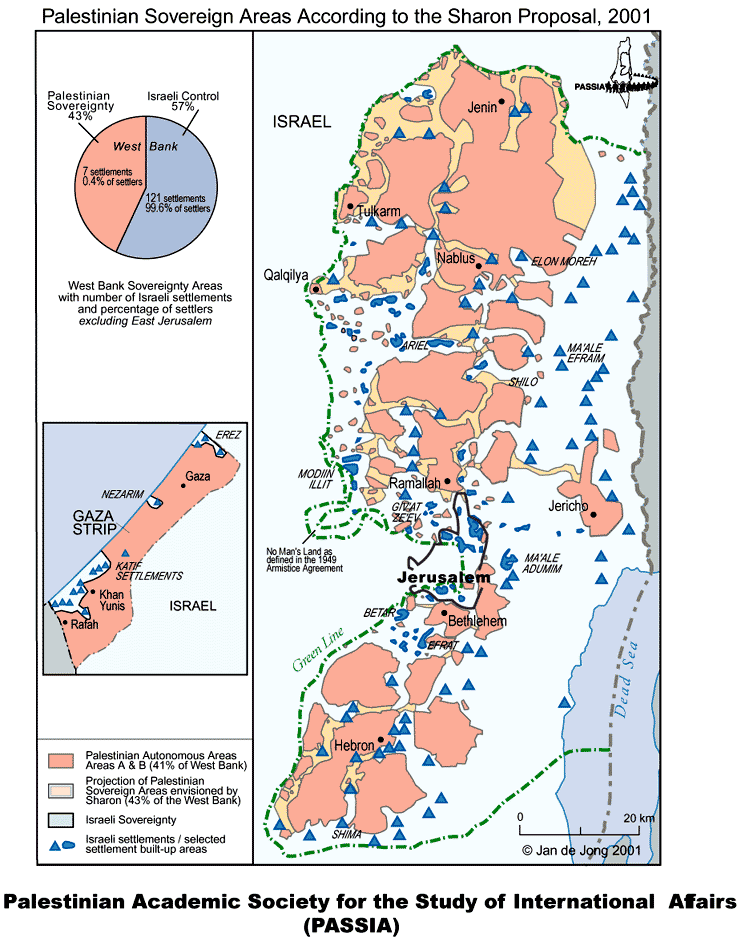
One of the reasons that I began writing these essays was to force myself to be more coherent and consistent in my thinking about complex issues. Some might argue that this is an entirely hopeless endeavor, but I will continue to struggle along. This piece and the two that will follow are therefore mostly for me as I try to answer two of the questions that have frequently been posed to me since I have returned from Israel/Palestine. Do you think any solution is possible? What do you think should happen? Most will probably say enough, enough. Only Middle East junkies, who, unfortunately, I think I have become, will want to get through all the complexity. If you decide to leave here, thanks for listening to my rambles. See you in a few weeks. Back to the questions- My off the cuff, flippant answer was been: “The US needs to get the hell out”. But these are valid questions and they deserve more consideration. Lets start by looking at where we are now. People say that we need to return to the “peace process”. What “peace process”? In the thirteen years since the Oslo agreements in which Yassar Arafat gave up his strategic vision of a single secular state in return for a  bunch of promises (none of them lived up to) and invitations to state dinners all over the world (I hope that the food and wine were good), the situation has continuously deteriorated. Neither side has lived up to its commitments and the proposed Palestinian state has been carved up into separate enclaves bounded by fences/walls, bypass roads and military reserves with no open borders and little internal communication and access. The Israeli governments of Benjamin Netanyahu, Ehud Barak and Ariel Sharon have, since 1993, attempted to establish irreversible facts on the ground in the form of settlements and annexations. They have succeeded. There are now approximately 400,000 settlers east of the 1967 armistice line who would have to be evacuated in order to return to these borders. The evacuation scenario of 8000 settlers in Gaza last year gives one some sense of what this would look like. When we asked if evacuating the settlement in Hebron would create an Israeli civil war, the spokesperson said “I wouldn’t call it probable, but I would call it possible.” This scenario is not politically feasible for the Israelis. The Sharon/Ohmert convergence/disengagement plan “only” requires that 50 – 100 settlements be dismantled and 50-100,000 settlers be expelled from their homes. Even this plan has a lot of opposition in Israel. (Click here to see how much) The disengagement plan (see the map) creates untenable borders for the “Palestinian state” and will never be accepted by any Palestinian government be it Hamas, Fatah or a reincarnation of Yassar Arafat. Can the US help resolve this seemingly irresolvable situation? Simple answer- No! The US has no role as an
 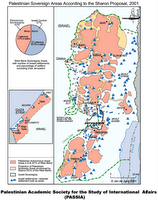 effective mediator. A mediator needs to be unbiased, willing to listen to the interests of both sides without judgment and find the common ground. With over 50 years of uncritical support for one side of the conflict, the US cannot be seen by Palestinians as unbiased. At Camp David, Palestinian negotiators dealing with Ehud Barak, Bill Clinton and AIPAC staffers Dennis Ross and Martin Indyck felt like they were negotiating with both Israel and the US. (They were probably right) That leaves us with question – Where do we go from here? Easy answer – beats me, but let’s look at this next time.
Israel
Palestine
Current Affairs
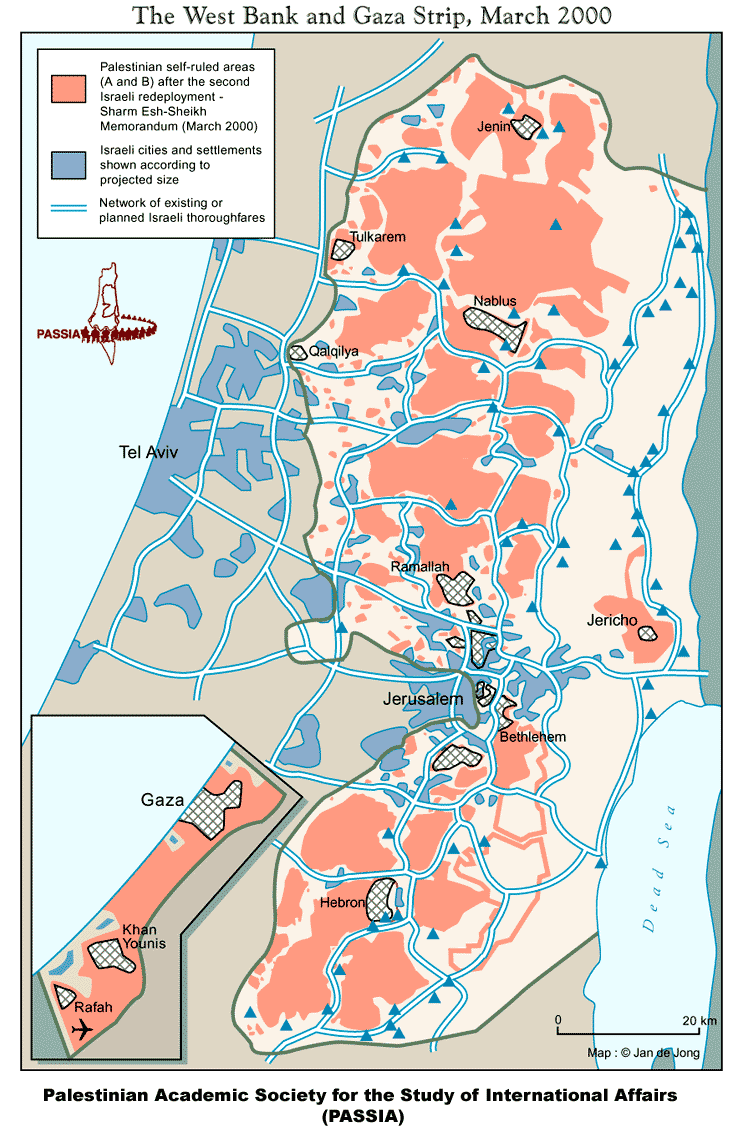 bunch of promises (none of them lived up to) and invitations to state dinners all over the world (I hope that the food and wine were good), the situation has continuously deteriorated. Neither side has lived up to its commitments and the proposed Palestinian state has been carved up into separate enclaves bounded by fences/walls, bypass roads and military reserves with no open borders and little internal communication and access. The Israeli governments of Benjamin Netanyahu, Ehud Barak and Ariel Sharon have, since 1993, attempted to establish irreversible facts on the ground in the form of settlements and annexations. They have succeeded. There are now approximately 400,000 settlers east of the 1967 armistice line who would have to be evacuated in order to return to these borders. The evacuation scenario of 8000 settlers in Gaza last year gives one some sense of what this would look like. When we asked if evacuating the settlement in Hebron would create an Israeli civil war, the spokesperson said “I wouldn’t call it probable, but I would call it possible.” This scenario is not politically feasible for the Israelis. The Sharon/Ohmert convergence/disengagement plan “only” requires that 50 – 100 settlements be dismantled and 50-100,000 settlers be expelled from their homes. Even this plan has a lot of opposition in Israel. (Click here to see how much) The disengagement plan (see the map) creates untenable borders for the “Palestinian state” and will never be accepted by any Palestinian government be it Hamas, Fatah or a reincarnation of Yassar Arafat. Can the US help resolve this seemingly irresolvable situation? Simple answer- No! The US has no role as an
  effective mediator. A mediator needs to be unbiased, willing to listen to the interests of both sides without judgment and find the common ground. With over 50 years of uncritical support for one side of the conflict, the US cannot be seen by Palestinians as unbiased. At Camp David, Palestinian negotiators dealing with Ehud Barak, Bill Clinton and AIPAC staffers Dennis Ross and Martin Indyck felt like they were negotiating with both Israel and the US. (They were probably right) That leaves us with question – Where do we go from here? Easy answer – beats me, but let’s look at this next time.
Israel
Palestine
Current Affairs
Tuesday, May 23, 2006
The Grandmother Effect
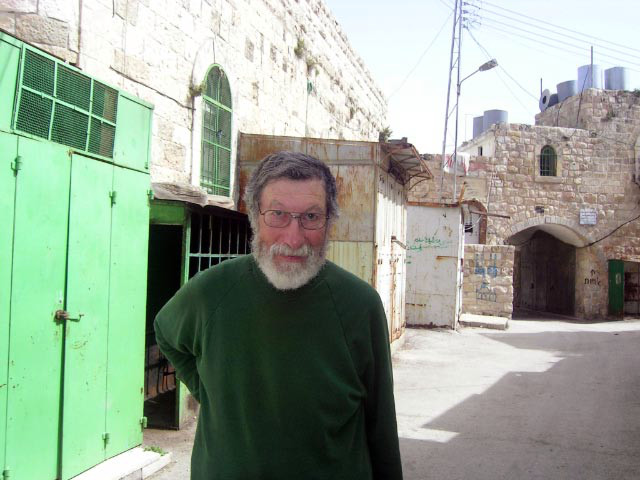
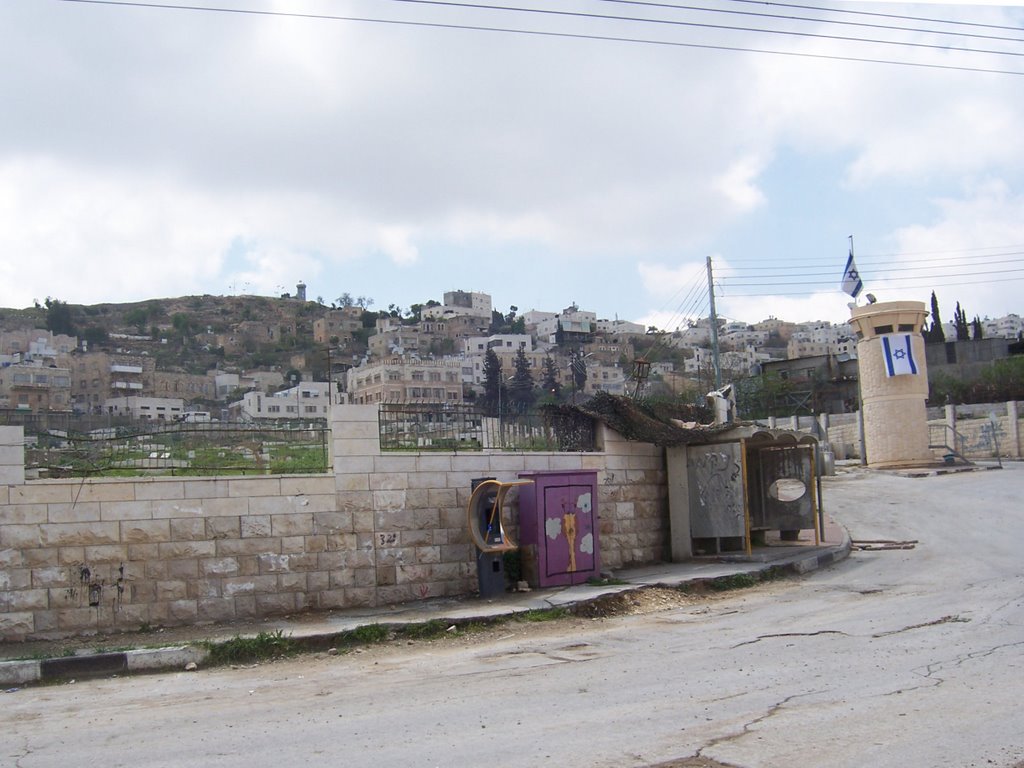
During our time on the West Bank of Israel/Palestine, I spent a day in the West Bank city of Hebron. Hebron is the site of the traditional tomb of Abraham and is therefore a holy place to all three monotheistic faiths. In many ways Hebron is a microcosm of the conflict in Israel/Palestine. This seems appropriate as this conflict is a conflict within the dysfunctional family of Abraham. It probably would have been better if he had had only one wife. Hebron is in the southern portion of the West Bank 30 minutes or two hours south of Bethlehem (depending on whether you are on the Jewish by-pass road or the Palestinian road). In Hebron there is a Jewish settlement of about 500 settlers (mostly American) in a city of 150,000 Arabs. (mostly Muslim) The settlers here represent the radical religious right of Jewish Israelis. David Wilder (an American from New Jersey), the spokesperson for this settlement, told us that his two state solution was Israel/Palestine for the Jews and Texas for the Palestinians. (I am not sure that he has consulted with George Bush on this.) Because the settlement is east, from an Israeli perspective “outside”, of the separation barrier/wall, the settlers are guarded by 2000 Israeli soldiers and security personnel. The result of this situation is a very unstable and sometimes violent relationship between the two populations. For this reason an organization called “Christian Peacemaker Teams” (CPT) has sent a group to monitor the situation and “get in the way of violence”. They call this “the grandmother effect”. There are some things that you won’t do when your grandmother is watching. (I think that our grandchildren could relate to this.) One of the things that they do is walk the Palestinian children to school in order to keep them from being hassled by the settlers
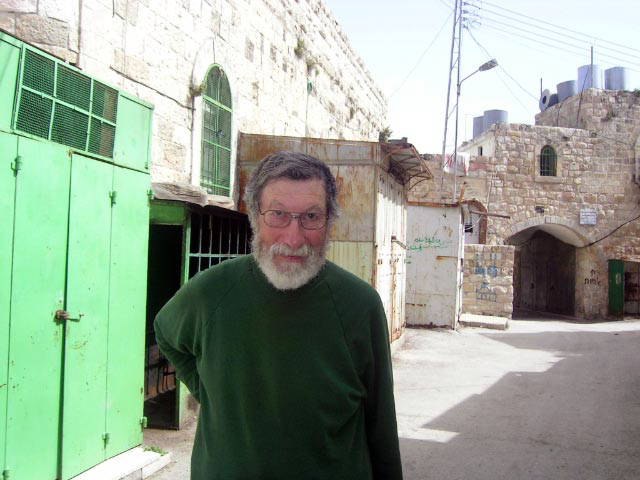 or the Israeli Defense Force (IDF) at the checkpoints.
John Lynes, a lawyer and a grandfather from the UK, told a story of needing to go to the market in order to prepare dinner. In order to get there, he had to pass down a street where the IDF and Palestinian “militants” were fighting each other. When they saw him, they stopped fighting and allowed him to pass. By the time he returned from the market, they were fighting again. Once again they stopped fighting and allowed him to pass only to resume when he was gone. Our Gospel reading for last Sunday was from the Gospel known to the church as John 15:13 “…no one has greater love than this, to lay down one’s life for one’s friends”. CPT seems to me to be the embodiment of this philosophy of unconditional love. Sometimes they lay down their lives literally as did Tom Fox in Iraq (if you don’t know this story, click here), but mostly they just lay down their normal lives, like yours and mine, to go where they are needed. (For more on CPT click here) Grandfathers and grandmothers encouraged to apply.
Wednesday, May 17, 2006
Tractors

When I was growing up in rural upstate New York, my brother and I used to wake up in the summer to the “put-put-put” of a 2 cylinder John Deere tractor that our neighbor down the road used to till his fields. This tractor has a very distinctive sound as it has a very large fly wheel and it seems like the engine only fires about twice a minute. To this day the sound of this vintage tractor still conjures up visions of green tractors, green corn fields and the smell of fresh mowed hay. Our recent trip to the West Bank of Israel/Palestine exposed me to a whole different vision of tractors. The rumble of an Israeli armored bulldozer combined with the “rat-tat-tat” of machine guns presents a completely different scenario. The image of these huge yellow pieces of equipment painted over in
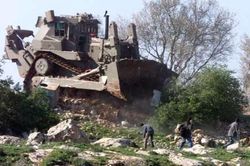 camouflage destroying olive groves, leveling houses and occasionally killing young American women (if you don’t know this story click here) can hardly be called bucolic. The destruction of homes and lives reeked by these tractors has brought the Caterpillar Company to the forefront of efforts by some liberal Protestant churches to encourage divestment from companies that facilitate the Israeli occupation of the West Bank and Gaza. (for more on this click here) When Caterpillar was contacted about this issue their response was that “we have no right to control how our customers use the pieces of equipment that we sell them.” For me it is hard to visualize what productive use could be made of an armored bulldozer with a machine gun on top. Maybe someone can enlighten me.
Tuesday, May 09, 2006
Shared Values
In a recent Washington Post op ed piece, "No, It's Not Anti-Semitic", columnist Richard Cohen comments on the controversy surrounding the paper on the Israel lobby by John Mearsheimer and Stephen Walt. Much of the criticism of Walt and Mearsheimer by such people as Eliot Cohen, professor at Johns Hopkins and Alan Dershowitz of Harvard argues that the paper reflects the anti-Semitism of the authors. In this piece Richard Cohen disagrees with this point of view. Instead he maintains that Mearsheimer and Walt’s argument that the Jewish community has a large influence on US policy is accurate. He states that “Israel’s special place is deserved, in my view, and not entirely the product of lobbying. Israel has earned it, and isn’t there something special about a relationship that is not based on oil or markets or strategic location but on shared values.” This got me to think that perhaps it is shared values that accounts for the US’s uncritical support for Israel and it’s policies. What might these shared values be? The first one that is usually cited is that we are both democracies, however flawed. This cannot be the only explanation as the Palestinian Territories and Iran are also democracies, however flawed. Another value that is frequently cited is that Israel is a strong ally of the US in the “war on terror”. In both countries this war effort defines “terror” very loosely including everyone from al Quada, ETA, Palestinians, the IRA, etc. in the same category. If your only tool is a hammer every problem looks like a nail. In both countries the war on terror is the number one foreign policy issue and justifies indefinite detentions of “militants” both citizens and non citizens. It also justifies surveillance, wire tapping and perhaps torture. Both countries also seem to believe that 40 ft walls will protect them from those who are different. We certainly do have shared values, but what kind of values are they? Are these the values that we want to teach our children? As I recall, there was a guy wandering around the Middle East 2000 years ago who had a different idea about what we should teach our children. It seems to me that Pastor Gary Arnold had it right. “Teach them to how to care about persons. Teach them to feel free enough to cry with others when they hurt. Teach them to offer helpful directions. Teach them to reach out and love, touch, and hold other persons when it feels like that is what you need to do. Teach them to be in touch with abiding values.” It seems that the values of our citizens and our governments are different. Our Arab friends when questioned about their feelings about Americans have often said “we know how to separate individuals from their government.” Why does that need to be?
Wednesday, May 03, 2006
Reaching out
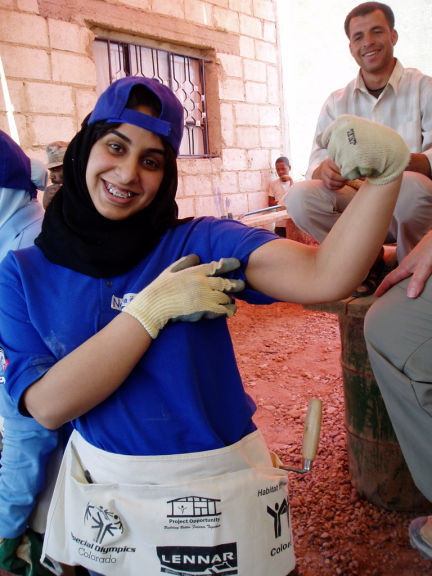
We, in the US, are often accused of being very insular and inward looking. Most of us only speak English and many of us have never traveled outside of the US. (Why should I do this when there is so much of this beautiful country that I have never seen?) We, however, are not the only ones with this attitude. The very conservative Gulf States in the Middle East keep many of their citizens, particularly the women, isolated from other cultures and the rest of the world. Recently, when I was in Jordan looking at some of the development projects with which I have been involved, we discussed with our friends at Habitat for Humanity-Jordan the upcoming work project by a group of very wealthy young women from an exclusive school in the UAE. They were concerned about what could be expected from these pampered and isolated young women. Could they lift the cement blocks? How would they interact with the people in the poor village? I said to Nancy at HFHJ "You have to send me an email after this work camp. This will be very interesting". I just received this email. What a great story of reaching outside your isolating borders. The story is at once uplifting and hopeful and also sad that they may never experience it again.
Nancy writes:
Happy Easter,
In this time of rebirth and transformation I have an incredible experience I
would like to celebrate with you. Last week we hosted the first all women's volunteer build in Jordan, maybe
the Middle East, but that has yet to be confirmed. The ladies were from
Sharjah College which is located in the United Arab Emirates, a small
country in the Persian Gulf. There were 12 students and 4 chaperones, one of
them being American. She was my main contact, Linda, an American teacher
with the school and she and I had many conversations about what this build
was going to look like given many factors. Some of those being that these
were wealthy young women, from very conservative families, one of them was a
princess from the current ruling family and they all wore the traditional head
scarf and robes. All but two of the girls had never traveled without a
member of their family before, several had never been in an airplane and for
most this would be the first and last trip of this nature. After graduation
they would be married and would not likely have this kind of opportunity
again.
We were anxious and apprehensive as to how this would all work out. Taking
young women into a poor community to build alongside men and members of a
community so vastly different than their world? Would they even be able to
lift a brick, much less be outside for hours at a time? By the end of the
very first day of building our fears were washed away in delight as we saw
the transformation of these women through their determination anopennessss.
As the staff sat together that evening we marveled at this and talked about
how we were going to have to change our build schedule to accommodate the
girls obvious ability to work harder than we had anticipated, this was a
challenge we were more than happy to have.
After the girls had dinner at night they gathered as a group to talk about
what they experienced that day. I wish I had the space here to share all of
these but will use this to share a few;
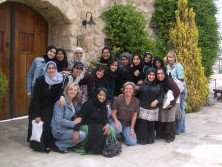
- Thuriyah - when I was walking back to the hotel from Petra I became very
sad because I realized this would be the last time that I would be on a trip
by myself. I love the way this trip makes me feel freedom, of just being me
and being able to be with my friends.
- Noorah (who actually is a princess) - I kept thinking all day about how
God made it possible for all these people from so many different places to
be here, today, right now, in the same place. I think that is amazing.
- Alawiah - I am so surprised at how easy it is to work around men, I don't
feel uncomfortable at all. I really like how different it is than being with
just women and people that I know well. It makes me feel good about myself.
(Linda tells me that this is an important chance for the girls who will be
allowed to take jobs and work in a place with men and women.)
- Moza - I am overwhelmed that people live like this. I have always known
there are poor people but have never seen them and could not have ever
dreamed that their lives would be like this. I feel so happy to have an
opportunity to help them and make a difference in how they live.
On a humorous note, Linda tells me that Noorah shows up at the airport with
her maid. When she realizes that she can't go through the check point with
her, she asks, who is going to carry my bags? Linda says, well you are.
Noorah says, OK, but I've never done that before. Later in the week she
tells Linda that she some of the things she has learned during the week were
to pack her own bags and do some laundry, she feels pretty proud of herself.
We all have different things to learn right?
The last day I sat in wonder as I watched with delight as these confident
young women, laughing, working side by side created contests to see who
could make more bricks. I also realize that being a woman has given me
incredible access to this whole experience and for that I am grateful.
This is grace, this is the kingdom.
Yours in love,
Nancy
This looks like the kingdom to me as well.
Jordan
Habitat for Humanity
UAE
Wednesday, April 26, 2006
Is life a dream?
One night at dinner my granddaughter asked the question “Is life a dream?” I answered “That’s a good question, Carly. I don’t know.” In our science and religion discussion group we have spent much time considering the nature of reality. Since neuroscientists tell us that the brain cannot tell the difference between what we actually see and what we imagine, the nature of reality is an open question. As Americans our relationship with reality is often one of keeping it at arms length. The closest that many of us want to get to reality is our couch in front of the TV watching a reality TV show. (Perhaps I am not a good one to comment on this as I may be the only person who has not seen even one episode of “Survivor”) Even our trips are designed to shield us from reality. If we want to see Africa we can go to African Safari in Disney World. That way we won’t have to experience the poverty stricken people, AIDs ravaged populations, poachers and the blood and killing of the prey predator relationship. If we want to see Venice without the canals that in many ways are just open sewers and without the destruction being caused by sinking land and rising sea levels, we can go the Venetian in Las Vegas with canals filled with filtered water and high end designer shops far from the sea. Soon, courtesy of the Israeli government, Jerry Falwell and Pat Robertson, we may be able experience the holy land of Israel/Palestine at a theme park in the Galilee. (This project took a little detour when Pat Robertson opined that God had caused Ariel Sharon’s stroke in revenge for pulling out of Gaza. However, money talks and the project will probably go forward.) We can then experience Bethlehem with lowing cattle and sleeping babies rather than barbed wire, walls, poverty, Apache helicopters, and targeted killings. We can experience Jerusalem without the crowds and glitz of the Church of the Holy Sepulcher and without fear of the random suicide bomber. We can experience a nice neat carpenter shop rather than the bustling Arab city of Nazareth. We will probably have to check our back packs and handbags at the entrance. Hopefully we will not have to check our brains as well.
Friday, April 21, 2006
A Community of Diversity
As our church begins the process of searching for a new rector, one of the steps in that process is to document who we are as a community. To accomplish this we are meeting in small groups to solicit input from all segments of the community. As I recently participated in one of these sessions, it was clear to me that we are a very diverse community. (In Sun Valley, Idaho maybe not ethnically diverse) We had people who would reject a new rector who would support participation by persons with alternative sexual preferences and people who would support the blessing same sex unions. We had people who thought the liturgy and music was the best part of the community and those who would change them completely. We had people who thought the church had too many programs and those who had ideas for more. People took both conservative and liberal positions; sometimes the same person in different places on different issues and sometimes husband and wife in different places. I realized that we can be diverse even as individuals. I was reminded of a conversation that we had at the Wi’am Peace Center in Bethlehem. We were discussing the importance in conflict resolution of knowing who the interested parties are. A very thoughtful young Palestinian woman pointed out that a person can be many different things at the same time. A person can be father, son, grandfather and uncle at the same time. She was Christian, Palestinian, Arab, woman, and teacher and sometimes had difficulty deciding in what order. She had concluded that what category she was first depended on where she was and who she was interacting with. One part must come first but they are all part of who we are. When we lose one part we are losing part of who we are. When both my parents die I will no longer be a son. I will lose part of who I am and that will be sad. We need to celebrate the diversity of individuals and of our communities. People outside of the US seem to celebrate our diversity more than we do. Our Jordanian driver told us his story of coming to the US on a tourist visa and overstaying his visa to work as a taxi driver in Queens. The pay was so good because of the danger that it was worth the risk. While doing that he fell in love with a beautiful black woman. He said “We were considering making the relationship more permanent, except when we went to consummate the relationship, she turned out to be a he. I love America”.
Thursday, April 13, 2006
The making of a police state
The state of Israel has long been an object of admiration by the American polity and there are many things to admire. Americans see many of the characteristics that they cherish in their own country in Israel. Here is a country carved out of a hostile land in a hostile environment by an energetic and tenacious people who have seen repression and persecution in their home lands. This admiration was manifest after 9/11 when the Israeli security forces and methods were held up as model of how the US should organize itself in order to prevent a reoccurrence of this horrific event. I remember numerous Israeli “security experts” opining in the media about the steps that we needed to take to deal with the threats posed by Islamic extremists. Maybe we should ask ourselves: “What lessons have we learned from our teachers”? When my friend Diane described her experience of crossing the Allenby bridge from Jordan to Israel a couple of years ago, she said “Now I know what it is like to live in a police state”. After two weeks of wandering around this part of the world, I know what she was talking about. The ever present police and defense forces manning established and “flying” check points, the efforts of interrogators to intimidate, the never ending stories of arrest and imprisonment without trial for the acts of being in the wrong place at the wrong time, the holding of the wrong political views or being of the wrong ethnic group or religion raise the questions: What is going on here? How did this happen? How does a liberal democracy morph into a police state? What are the characteristics that allow this to happen? I used to feel that this couldn’t happen in a democracy. I was willing to accept some restrictions on my personal freedom and privacy in order to be able to go on with my life in a secure environment. The US is a democracy. If our government went too far in this direction all we had to do was go to the polls and “throw the bums out”. Only the people on the “wacky left” at the ACLU worried about such things. Why hasn’t this worked in Israel? Why didn’t the Israeli polity rise up and say “enough is enough”? We are not going to live like this and we are not going to treat other people like this. Some of the characteristics of Israeli society that I have observed may help shed some light on the answers to these questions. It seems to me that living in an environment where there is an ongoing threat of random or intentional attack has given the Israeli people an overriding concern for security. They have also developed as a people a xenophobic fear of the outsider, the other. Part of this other is an unstable internal population made up of second class citizens and immigrants with no status or permanent ties to the society. There is also a large degree of political apathy in the society. (I can have no effect on the outcome so why bother) In an election that was billed as one of the most important in Israel’s history, one that would dramatically affect the future of Israel only 60 percent of the electorate expressed their opinion. As I think about this, I find myself saying “hmm, this sounds familiar” Be careful who your teachers are.
Saturday, April 08, 2006
Journey through Palestine
Our time in Israel/Palestine has placed us all on sensory and intellectual overload. It is way too soon to do more than just describe the experience. Reflection and absorption will have to wait for another day. Unfortunately we arrived a day late as we were unable to connect with our Atlanta to Tel Aviv flight. (You’ve got to love Delta) Passport control was no problem. Our beautiful Israeli immigration officer asked us a few questions and then wished us a good trip. (This isn’t so bad; easier than coming back into the US) As we passed into Ben Gurion airport we were greeted by a modern airport with no one in it. We were also greeted by no one. This was a disconcerting start to a trip that had everyone apprehensive to begin with. As we were soon to discover, this was an omen of things to come in the future. Our Palestinian driver was held up an hour and a half at the airport security point while they completely searched his van. Once connected, we headed off for the Bethlehem check point at the wall. Passing through Jerusalem it looks like any other large Middle Eastern city. (Jerusalem stone with the requisite McDonald’s) As you approach the wall/checkpoint, you see the picture that you have seen many times in the media. (30-40ft wall with gun towers and barbed wire) Somehow, however, it seems different when you are actually there. In what may be the epitome of irony the wall displays a huge sign placed by the Israeli government at Christmas time – “Peace on Earth”. After an uneventful passage through the checkpoint we arrived at the Casa Nova hotel on Manger Square for dinner with local wine and looked forward to the next day.
Day two brought us to the Wi’am Center for an introduction to conflict resolution. For the center, business is good – “this is a good season for conflict”. Although the case we discussed involved a domestic dispute, it was easy to see the parallels with the larger conflict and the approach to solving the dispute seemed obvious. (more irony) After a tour of the Church of the Nativity (it was hard to find God among all the glitz) we returned to the center to view the documentary film “Rachel Corrie – An American Conscience”. http://www.rachelcorrie.org/ This powerful, disturbing and graphic film tells the story of a 23 year old American women killed by an Israeli bulldozer while non-violently defending a Palestinian family’s home. In the moving discussion following the film, a group of Palestinian young adults (mixed Christian and Muslim) described why she is such a heroine for the Palestinians. (Life is made up of choices. We are here because we have to be-it is our home. She made a choice to be here with us) My observation is that this courageous young woman has done more to change the opinion of the Palestinians of the American people than all the millions spent by the US government on PR.
Day three had us heading “down to Jericho” after a tremendous rainstorm the night before which closed roads, flooded areas of cities and put rivers where they had never been before. Because we were Palestinians our journey was on the Jericho road, a winding narrow road full of Israeli army checkpoints which parallels the bypass road to Jericho reserved for Israelis. This turns a 40 minute trip on the bypass road into 2 hour excursion. As we entered the city and a visit to Temptation Mountain on dismal rainy day we passed the prison and government office compound attacked and leveled by Israeli tanks the week before. We hiked up to the Greek Orthodox Monastery at the peak just in time to have the sun break through. On the way I met a Palestinian policeman from Chicago who described his years in the US. Upon leaving Jericho we headed to the Dead Sea. The resort (if you can call it that) on the Israeli side is pretty tacky. (It is not in danger of enticing us from the Movenpick Hotel on the Jordanian side) We spent a brief amount of time there before proceeding back to Bethlehem for a meeting with Mitri Raheb, pastor of Christmas Lutheran Church. We were uncertain as to what to expect in Bethlehem as the night before the Israelis had killed a Palestinian “militant” outside of Bethlehem and there was a general strike in the city. Upon arrival, the city was very quiet and we had no problem getting to our appointment. This very impressive man of God described the mission of Christmas Lutheran Church (“The Israelis are trying to build the world’s largest outdoor prison and they will probably succeed. We are trying to make it the world’s best outdoor prison”) and what they are trying to do to fulfill this mission. We ate dinner at the church as all the restaurants in the city were closed. After dinner we walked the few blocks back to the Casa Nova hotel. For many of us this was the scariest part of the trip thus far. As we walked, an unlighted Israeli Apache helicopter circled overhead. If this guy is looking to target a “militant”, who might be in a car passing us on the street, we could become “collateral damage”. Usama from the Wi’am Center who was walking with me said “If I were walking with my wife and kids, I would run and hide.” This didn’t add to my level of comfort. We were all grateful to arrive at Casa Nova in one piece.
Day four dawned on our trip to Hebron. Hebron, a partitioned city of 140,000 Muslim Palestinians, contains the traditional burial place of Abraham, a site holy to Jews and Muslims, as well as an outpost Israeli settlement containing 400-600 people (mostly Americans) protected by 2000 Israeli soldiers and security personnel. These settlers are among the most radical in Israel. We were all apprehensive as we approached the settlement surrounded by gun emplacements and armed soldiers for our meeting with David Wilder, a spokesperson for the settlement from New Jersey. David was open and frank in discussing the history of the settlement (including the 1929 massacre of 69 Jews), how it functions and his political philosophy. (“I believe in a two state solution – Israel/Palestine for the Jews and Texas for the Palestinians”) After a tour of the settlement we were all happy to be back in the Arab section with friendly policemen and bright eyed children and the bus trip home.
As we awoke on day five we were informed by a Palestinian policeman that the Israeli’s had killed another “militant” outside of Bethlehem during the night. We were concerned that this second killing would provoke a reaction from the Palestinians, but Suzy, the assistant hotel manager told us at breakfast “no problem, this is normal, this is our life". All seemed quiet so we journeyed through wall/security fence to Jerusalem for a tour of the city and holy sites and a meeting with Mordechai Vanunu, the Israeli nuclear scientist who blew the whistle on the Israeli nuclear program. We heard his chilling tale of kidnapping and drugging followed by trial and 18 years in prison in solitary confinement. By meeting with us he was risking additional prison time as one of the conditions of his release was that he not talk to the press or any foreigners. After the discussion, we hiked down the Mount of Olives with Mordechai including a stop at the Church of Tears for a very appropriate reading of Luke 13 where Jesus grieves over Jerusalem.
It was a pretty somber group that left our friends in Bethlehem on day six for Abuna (now Bishop) Chacour’s school in Ibillin. We had an up lifting conversation with Bishop Chacour and three charming young Palestinian ladies who are majoring in communications and who are headed for summer session in July at the University of Indianapolis. When one of our group who had been in a home stay commented that, after all they have been through, he was amazed that the Palestinians do not hate the Israelis, Bishop Chacour responded “Isn’t that amazing? I have no explanation; it makes no sense.” We left the next morning for the airport and the trip to Jordan to the sight of 4500 kids and young people arriving at school to the music from Star Wars
Day two brought us to the Wi’am Center for an introduction to conflict resolution. For the center, business is good – “this is a good season for conflict”. Although the case we discussed involved a domestic dispute, it was easy to see the parallels with the larger conflict and the approach to solving the dispute seemed obvious. (more irony) After a tour of the Church of the Nativity (it was hard to find God among all the glitz) we returned to the center to view the documentary film “Rachel Corrie – An American Conscience”. http://www.rachelcorrie.org/ This powerful, disturbing and graphic film tells the story of a 23 year old American women killed by an Israeli bulldozer while non-violently defending a Palestinian family’s home. In the moving discussion following the film, a group of Palestinian young adults (mixed Christian and Muslim) described why she is such a heroine for the Palestinians. (Life is made up of choices. We are here because we have to be-it is our home. She made a choice to be here with us) My observation is that this courageous young woman has done more to change the opinion of the Palestinians of the American people than all the millions spent by the US government on PR.
Day three had us heading “down to Jericho” after a tremendous rainstorm the night before which closed roads, flooded areas of cities and put rivers where they had never been before. Because we were Palestinians our journey was on the Jericho road, a winding narrow road full of Israeli army checkpoints which parallels the bypass road to Jericho reserved for Israelis. This turns a 40 minute trip on the bypass road into 2 hour excursion. As we entered the city and a visit to Temptation Mountain on dismal rainy day we passed the prison and government office compound attacked and leveled by Israeli tanks the week before. We hiked up to the Greek Orthodox Monastery at the peak just in time to have the sun break through. On the way I met a Palestinian policeman from Chicago who described his years in the US. Upon leaving Jericho we headed to the Dead Sea. The resort (if you can call it that) on the Israeli side is pretty tacky. (It is not in danger of enticing us from the Movenpick Hotel on the Jordanian side) We spent a brief amount of time there before proceeding back to Bethlehem for a meeting with Mitri Raheb, pastor of Christmas Lutheran Church. We were uncertain as to what to expect in Bethlehem as the night before the Israelis had killed a Palestinian “militant” outside of Bethlehem and there was a general strike in the city. Upon arrival, the city was very quiet and we had no problem getting to our appointment. This very impressive man of God described the mission of Christmas Lutheran Church (“The Israelis are trying to build the world’s largest outdoor prison and they will probably succeed. We are trying to make it the world’s best outdoor prison”) and what they are trying to do to fulfill this mission. We ate dinner at the church as all the restaurants in the city were closed. After dinner we walked the few blocks back to the Casa Nova hotel. For many of us this was the scariest part of the trip thus far. As we walked, an unlighted Israeli Apache helicopter circled overhead. If this guy is looking to target a “militant”, who might be in a car passing us on the street, we could become “collateral damage”. Usama from the Wi’am Center who was walking with me said “If I were walking with my wife and kids, I would run and hide.” This didn’t add to my level of comfort. We were all grateful to arrive at Casa Nova in one piece.
Day four dawned on our trip to Hebron. Hebron, a partitioned city of 140,000 Muslim Palestinians, contains the traditional burial place of Abraham, a site holy to Jews and Muslims, as well as an outpost Israeli settlement containing 400-600 people (mostly Americans) protected by 2000 Israeli soldiers and security personnel. These settlers are among the most radical in Israel. We were all apprehensive as we approached the settlement surrounded by gun emplacements and armed soldiers for our meeting with David Wilder, a spokesperson for the settlement from New Jersey. David was open and frank in discussing the history of the settlement (including the 1929 massacre of 69 Jews), how it functions and his political philosophy. (“I believe in a two state solution – Israel/Palestine for the Jews and Texas for the Palestinians”) After a tour of the settlement we were all happy to be back in the Arab section with friendly policemen and bright eyed children and the bus trip home.
As we awoke on day five we were informed by a Palestinian policeman that the Israeli’s had killed another “militant” outside of Bethlehem during the night. We were concerned that this second killing would provoke a reaction from the Palestinians, but Suzy, the assistant hotel manager told us at breakfast “no problem, this is normal, this is our life". All seemed quiet so we journeyed through wall/security fence to Jerusalem for a tour of the city and holy sites and a meeting with Mordechai Vanunu, the Israeli nuclear scientist who blew the whistle on the Israeli nuclear program. We heard his chilling tale of kidnapping and drugging followed by trial and 18 years in prison in solitary confinement. By meeting with us he was risking additional prison time as one of the conditions of his release was that he not talk to the press or any foreigners. After the discussion, we hiked down the Mount of Olives with Mordechai including a stop at the Church of Tears for a very appropriate reading of Luke 13 where Jesus grieves over Jerusalem.
It was a pretty somber group that left our friends in Bethlehem on day six for Abuna (now Bishop) Chacour’s school in Ibillin. We had an up lifting conversation with Bishop Chacour and three charming young Palestinian ladies who are majoring in communications and who are headed for summer session in July at the University of Indianapolis. When one of our group who had been in a home stay commented that, after all they have been through, he was amazed that the Palestinians do not hate the Israelis, Bishop Chacour responded “Isn’t that amazing? I have no explanation; it makes no sense.” We left the next morning for the airport and the trip to Jordan to the sight of 4500 kids and young people arriving at school to the music from Star Wars
Friday, March 24, 2006
Walls - Who lives in the ghetto?

As we have prepared for our journey to the Middle East, one of our fellow travelers asked the question: "Will we able to get around?" She was concerned that she would not be able to go where she needed to go in order to talk to the people that she wanted to talk to and get done what she wanted to get done. There are real limitations on movement within the West Bank as a result of the barriers that have been constructed to separate Jews and Palestinians. I was reminded of other barriers famous and infamous, old and new that have been used to separate one group from the "other". Whether a barrier is a security fence or an apartheid wall seems to me to depend on which side of the fence
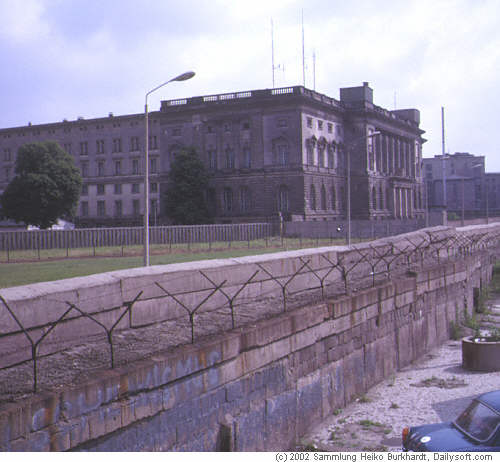 you are on and who built it. When people look at these pictures of various walls of history, they can readily identify the Warsaw Ghetto, the Berlin Wall and the barrier between Israel and the West Bank. The one that they have trouble with is the last one. This is surprising since it is the one closest to home. It is in San Diego and separates the US from Mexico. The newer barriers may look more high tech than the older ones, but they serve the same purpose. We seem to have learned very well from the Nazis and the Soviet Union. (Anything you can do, I can do better.) When fear causes us to wall the stranger, the other, the different out, we at the same time wall ourselves into our own
 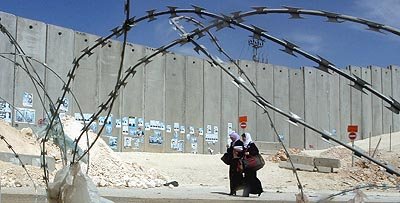 ghetto. Some evolutionary biologists like E. O. Wilson would argue that this behavior is part of our genetic code, evolved over millions of years as protective defense mechanism. We are coded to identify and exclude those that are not members of our tribe as they are potential enemies who would destroy us and prevent us from surviving. This behavior is not good or bad, but is morally neutral. Others, I among them, would argue that we are created in the "image of God" and have the ability to make a moral choice based on our "God given" sense of what is right. We may, however, choose to ignore this "voice of God" and this choice certainly is affected by our cultural environment. In the US our politicians have influenced this environment by succeeding in making the term "pre 9/11 mentality" a pejorative term. George Bush accused John Kerry of having a "pre 9/11 mentality". During the Dubai Ports World controversy the Democratic Congressional Campaign Committee issued this statement: "Republicans have a pre 9/11 mentality" As we cower in fear behind our barriers and in our
 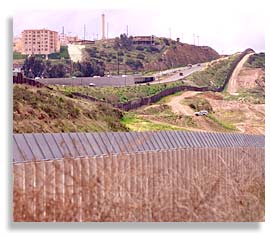 ghettos, maybe what we need is not less of a "pre 9/11 mentality" but more.
In the Gospels, the apostle known to the church as Mark, has Jesus say " whoever does not receive the kingdom of God like a little child will never enter it." When I read this passage, I am reminded of words from our now 7 year old granddaughter when she was 3 years old. As we were walking with her in Denver, she announced: "I'm Carly Liebich and everybody is my friend" Talk about a "pre 9/11 mentality". Of such is the kingdom of heaven
Wednesday, March 22, 2006
Why do we do what we do?
After considerable reflection, I have decided to become a member of the chattering class. I find that putting my thoughts down on paper (or in this case on a computer) helps me to make them more coherent. (Although after reading this some might disagree) I hope to periodically comment on issues and topics that interest me. (They may be of more interest to me than to readers) One of the problems with a blog is that sometimes you can end up between a page of chicken recipes and a porn site, but you can't always choose your neighbors.
As I prepare to leave for two weeks in Israel, Jordan and the West Bank, I am reminded that I, as well as others in our group, am venturing outside of my comfort zone. Although I have been to Jordan several times with Habitat for Humanity and have been to many other off the beaten path places, this will be my first visit to the sometime war zone that is Israel and the West Bank. Fortunately, in his sermon a couple of weeks ago about Jesus’ disciples following him to his death in Jerusalem, Father Brian reminded us all that it is OK to step outside our comfort zone, to take up our cross and to go to Jerusalem.
Needless to say, I have been keeping a close eye on what is happening in this volatile area of the world on various sources of news and information. Since Al Jareeza provides one of the most complete sources of news on the Middle East, I have been a regular reader. In this process, I came across an article which described a paper written by Stephen Walt, Professor at Harvard and John Mearsheimer of the University of Chicago on US Middle East policy. (The Israel Lobby and US Foreign Policy) They pose the question “Why has the US been willing to set aside its own security and that of many of its allies in order to advance the interests of another state?” I have asked that question in another way. Why is it in real politic interest of the US to maintain a client state in the Middle East at great cost (20% of our foreign aid budget) when this client state often operates in opposition to our national interest? It might have made sense during the cold war to counteract Soviet client states, but does it still make sense? Walt and Mearsheimer answer the question this way: “…the thrust of US policy in the region derives almost entirely from domestic politics and especially the activities of the ‘Israel Lobby’.”
I have seen no commentary on the paper it self in the US media. (at 83 pages it is not an easy read) What I have seen and heard is aggressive negative responses from a number of sources including Marvin Kalb, Lecturer at Harvard and 30 year journalist with NBC and CBS and Dennis Ross, Middle East ambassador in the first Bush and Clinton administrations as reported on Fox News. (Both of these gentlemen may have reasons to protest as they have long time relationships with AIPAC)
Today produced a negative op-ed piece in the Wall Street Journal by Ruth Wisse, Professor of Yiddish Literature at Harvard. Her answer to the question posed by Walt and Mearsheimer is “Israel fights our battles better than we fight them ourselves.” (She got this answer from a Boston taxi driver) She also provides insightful criticism of the paper as “wacko, quacko”, containing “bloopers, distortions and omissions” and an “anti-Semitic lie”.
I am reminded of a piece of advice that was given to Marcia and me early in our marriage which has contributed to our 42 years together. In a dispute “the person yelling the loudest is usually the one that is wrong” Stay tuned to see who is yelling the loudest.
Israel
Stephen Walt
John Mearsheimer
As I prepare to leave for two weeks in Israel, Jordan and the West Bank, I am reminded that I, as well as others in our group, am venturing outside of my comfort zone. Although I have been to Jordan several times with Habitat for Humanity and have been to many other off the beaten path places, this will be my first visit to the sometime war zone that is Israel and the West Bank. Fortunately, in his sermon a couple of weeks ago about Jesus’ disciples following him to his death in Jerusalem, Father Brian reminded us all that it is OK to step outside our comfort zone, to take up our cross and to go to Jerusalem.
Needless to say, I have been keeping a close eye on what is happening in this volatile area of the world on various sources of news and information. Since Al Jareeza provides one of the most complete sources of news on the Middle East, I have been a regular reader. In this process, I came across an article which described a paper written by Stephen Walt, Professor at Harvard and John Mearsheimer of the University of Chicago on US Middle East policy. (The Israel Lobby and US Foreign Policy) They pose the question “Why has the US been willing to set aside its own security and that of many of its allies in order to advance the interests of another state?” I have asked that question in another way. Why is it in real politic interest of the US to maintain a client state in the Middle East at great cost (20% of our foreign aid budget) when this client state often operates in opposition to our national interest? It might have made sense during the cold war to counteract Soviet client states, but does it still make sense? Walt and Mearsheimer answer the question this way: “…the thrust of US policy in the region derives almost entirely from domestic politics and especially the activities of the ‘Israel Lobby’.”
I have seen no commentary on the paper it self in the US media. (at 83 pages it is not an easy read) What I have seen and heard is aggressive negative responses from a number of sources including Marvin Kalb, Lecturer at Harvard and 30 year journalist with NBC and CBS and Dennis Ross, Middle East ambassador in the first Bush and Clinton administrations as reported on Fox News. (Both of these gentlemen may have reasons to protest as they have long time relationships with AIPAC)
Today produced a negative op-ed piece in the Wall Street Journal by Ruth Wisse, Professor of Yiddish Literature at Harvard. Her answer to the question posed by Walt and Mearsheimer is “Israel fights our battles better than we fight them ourselves.” (She got this answer from a Boston taxi driver) She also provides insightful criticism of the paper as “wacko, quacko”, containing “bloopers, distortions and omissions” and an “anti-Semitic lie”.
I am reminded of a piece of advice that was given to Marcia and me early in our marriage which has contributed to our 42 years together. In a dispute “the person yelling the loudest is usually the one that is wrong” Stay tuned to see who is yelling the loudest.
Israel
Stephen Walt
John Mearsheimer
Subscribe to:
Posts (Atom)