Wednesday, April 26, 2006
Is life a dream?
One night at dinner my granddaughter asked the question “Is life a dream?” I answered “That’s a good question, Carly. I don’t know.” In our science and religion discussion group we have spent much time considering the nature of reality. Since neuroscientists tell us that the brain cannot tell the difference between what we actually see and what we imagine, the nature of reality is an open question. As Americans our relationship with reality is often one of keeping it at arms length. The closest that many of us want to get to reality is our couch in front of the TV watching a reality TV show. (Perhaps I am not a good one to comment on this as I may be the only person who has not seen even one episode of “Survivor”) Even our trips are designed to shield us from reality. If we want to see Africa we can go to African Safari in Disney World. That way we won’t have to experience the poverty stricken people, AIDs ravaged populations, poachers and the blood and killing of the prey predator relationship. If we want to see Venice without the canals that in many ways are just open sewers and without the destruction being caused by sinking land and rising sea levels, we can go the Venetian in Las Vegas with canals filled with filtered water and high end designer shops far from the sea. Soon, courtesy of the Israeli government, Jerry Falwell and Pat Robertson, we may be able experience the holy land of Israel/Palestine at a theme park in the Galilee. (This project took a little detour when Pat Robertson opined that God had caused Ariel Sharon’s stroke in revenge for pulling out of Gaza. However, money talks and the project will probably go forward.) We can then experience Bethlehem with lowing cattle and sleeping babies rather than barbed wire, walls, poverty, Apache helicopters, and targeted killings. We can experience Jerusalem without the crowds and glitz of the Church of the Holy Sepulcher and without fear of the random suicide bomber. We can experience a nice neat carpenter shop rather than the bustling Arab city of Nazareth. We will probably have to check our back packs and handbags at the entrance. Hopefully we will not have to check our brains as well.


Friday, April 21, 2006
A Community of Diversity
As our church begins the process of searching for a new rector, one of the steps in that process is to document who we are as a community. To accomplish this we are meeting in small groups to solicit input from all segments of the community. As I recently participated in one of these sessions, it was clear to me that we are a very diverse community. (In Sun Valley, Idaho maybe not ethnically diverse) We had people who would reject a new rector who would support participation by persons with alternative sexual preferences and people who would support the blessing same sex unions. We had people who thought the liturgy and music was the best part of the community and those who would change them completely. We had people who thought the church had too many programs and those who had ideas for more. People took both conservative and liberal positions; sometimes the same person in different places on different issues and sometimes husband and wife in different places. I realized that we can be diverse even as individuals. I was reminded of a conversation that we had at the Wi’am Peace Center in Bethlehem. We were discussing the importance in conflict resolution of knowing who the interested parties are. A very thoughtful young Palestinian woman pointed out that a person can be many different things at the same time. A person can be father, son, grandfather and uncle at the same time. She was Christian, Palestinian, Arab, woman, and teacher and sometimes had difficulty deciding in what order. She had concluded that what category she was first depended on where she was and who she was interacting with. One part must come first but they are all part of who we are. When we lose one part we are losing part of who we are. When both my parents die I will no longer be a son. I will lose part of who I am and that will be sad. We need to celebrate the diversity of individuals and of our communities. People outside of the US seem to celebrate our diversity more than we do. Our Jordanian driver told us his story of coming to the US on a tourist visa and overstaying his visa to work as a taxi driver in Queens. The pay was so good because of the danger that it was worth the risk. While doing that he fell in love with a beautiful black woman. He said “We were considering making the relationship more permanent, except when we went to consummate the relationship, she turned out to be a he. I love America”.
Thursday, April 13, 2006
The making of a police state
The state of Israel has long been an object of admiration by the American polity and there are many things to admire. Americans see many of the characteristics that they cherish in their own country in Israel. Here is a country carved out of a hostile land in a hostile environment by an energetic and tenacious people who have seen repression and persecution in their home lands. This admiration was manifest after 9/11 when the Israeli security forces and methods were held up as model of how the US should organize itself in order to prevent a reoccurrence of this horrific event. I remember numerous Israeli “security experts” opining in the media about the steps that we needed to take to deal with the threats posed by Islamic extremists. Maybe we should ask ourselves: “What lessons have we learned from our teachers”? When my friend Diane described her experience of crossing the Allenby bridge from Jordan to Israel a couple of years ago, she said “Now I know what it is like to live in a police state”. After two weeks of wandering around this part of the world, I know what she was talking about. The ever present police and defense forces manning established and “flying” check points, the efforts of interrogators to intimidate, the never ending stories of arrest and imprisonment without trial for the acts of being in the wrong place at the wrong time, the holding of the wrong political views or being of the wrong ethnic group or religion raise the questions: What is going on here? How did this happen? How does a liberal democracy morph into a police state? What are the characteristics that allow this to happen? I used to feel that this couldn’t happen in a democracy. I was willing to accept some restrictions on my personal freedom and privacy in order to be able to go on with my life in a secure environment. The US is a democracy. If our government went too far in this direction all we had to do was go to the polls and “throw the bums out”. Only the people on the “wacky left” at the ACLU worried about such things. Why hasn’t this worked in Israel? Why didn’t the Israeli polity rise up and say “enough is enough”? We are not going to live like this and we are not going to treat other people like this. Some of the characteristics of Israeli society that I have observed may help shed some light on the answers to these questions. It seems to me that living in an environment where there is an ongoing threat of random or intentional attack has given the Israeli people an overriding concern for security. They have also developed as a people a xenophobic fear of the outsider, the other. Part of this other is an unstable internal population made up of second class citizens and immigrants with no status or permanent ties to the society. There is also a large degree of political apathy in the society. (I can have no effect on the outcome so why bother) In an election that was billed as one of the most important in Israel’s history, one that would dramatically affect the future of Israel only 60 percent of the electorate expressed their opinion. As I think about this, I find myself saying “hmm, this sounds familiar” Be careful who your teachers are.
Saturday, April 08, 2006
Journey through Palestine
Our time in Israel/Palestine has placed us all on sensory and intellectual overload. It is way too soon to do more than just describe the experience. Reflection and absorption will have to wait for another day. Unfortunately we arrived a day late as we were unable to connect with our Atlanta to Tel Aviv flight. (You’ve got to love Delta) Passport control was no problem. Our beautiful Israeli immigration officer asked us a few questions and then wished us a good trip. (This isn’t so bad; easier than coming back into the US) As we passed into Ben Gurion airport we were greeted by a modern airport with no one in it. We were also greeted by no one. This was a disconcerting start to a trip that had everyone apprehensive to begin with. As we were soon to discover, this was an omen of things to come in the future. Our Palestinian driver was held up an hour and a half at the airport security point while they completely searched his van. Once connected, we headed off for the Bethlehem check point at the wall. Passing through Jerusalem it looks like any other large Middle Eastern city. (Jerusalem stone with the requisite McDonald’s) As you approach the wall/checkpoint, you see the picture that you have seen many times in the media. (30-40ft wall with gun towers and barbed wire) Somehow, however, it seems different when you are actually there. In what may be the epitome of irony the wall displays a huge sign placed by the Israeli government at Christmas time – “Peace on Earth”. After an uneventful passage through the checkpoint we arrived at the Casa Nova hotel on Manger Square for dinner with local wine and looked forward to the next day.
Day two brought us to the Wi’am Center for an introduction to conflict resolution. For the center, business is good – “this is a good season for conflict”. Although the case we discussed involved a domestic dispute, it was easy to see the parallels with the larger conflict and the approach to solving the dispute seemed obvious. (more irony) After a tour of the Church of the Nativity (it was hard to find God among all the glitz) we returned to the center to view the documentary film “Rachel Corrie – An American Conscience”. http://www.rachelcorrie.org/ This powerful, disturbing and graphic film tells the story of a 23 year old American women killed by an Israeli bulldozer while non-violently defending a Palestinian family’s home. In the moving discussion following the film, a group of Palestinian young adults (mixed Christian and Muslim) described why she is such a heroine for the Palestinians. (Life is made up of choices. We are here because we have to be-it is our home. She made a choice to be here with us) My observation is that this courageous young woman has done more to change the opinion of the Palestinians of the American people than all the millions spent by the US government on PR.
Day three had us heading “down to Jericho” after a tremendous rainstorm the night before which closed roads, flooded areas of cities and put rivers where they had never been before. Because we were Palestinians our journey was on the Jericho road, a winding narrow road full of Israeli army checkpoints which parallels the bypass road to Jericho reserved for Israelis. This turns a 40 minute trip on the bypass road into 2 hour excursion. As we entered the city and a visit to Temptation Mountain on dismal rainy day we passed the prison and government office compound attacked and leveled by Israeli tanks the week before. We hiked up to the Greek Orthodox Monastery at the peak just in time to have the sun break through. On the way I met a Palestinian policeman from Chicago who described his years in the US. Upon leaving Jericho we headed to the Dead Sea. The resort (if you can call it that) on the Israeli side is pretty tacky. (It is not in danger of enticing us from the Movenpick Hotel on the Jordanian side) We spent a brief amount of time there before proceeding back to Bethlehem for a meeting with Mitri Raheb, pastor of Christmas Lutheran Church. We were uncertain as to what to expect in Bethlehem as the night before the Israelis had killed a Palestinian “militant” outside of Bethlehem and there was a general strike in the city. Upon arrival, the city was very quiet and we had no problem getting to our appointment. This very impressive man of God described the mission of Christmas Lutheran Church (“The Israelis are trying to build the world’s largest outdoor prison and they will probably succeed. We are trying to make it the world’s best outdoor prison”) and what they are trying to do to fulfill this mission. We ate dinner at the church as all the restaurants in the city were closed. After dinner we walked the few blocks back to the Casa Nova hotel. For many of us this was the scariest part of the trip thus far. As we walked, an unlighted Israeli Apache helicopter circled overhead. If this guy is looking to target a “militant”, who might be in a car passing us on the street, we could become “collateral damage”. Usama from the Wi’am Center who was walking with me said “If I were walking with my wife and kids, I would run and hide.” This didn’t add to my level of comfort. We were all grateful to arrive at Casa Nova in one piece.
Day four dawned on our trip to Hebron. Hebron, a partitioned city of 140,000 Muslim Palestinians, contains the traditional burial place of Abraham, a site holy to Jews and Muslims, as well as an outpost Israeli settlement containing 400-600 people (mostly Americans) protected by 2000 Israeli soldiers and security personnel. These settlers are among the most radical in Israel. We were all apprehensive as we approached the settlement surrounded by gun emplacements and armed soldiers for our meeting with David Wilder, a spokesperson for the settlement from New Jersey. David was open and frank in discussing the history of the settlement (including the 1929 massacre of 69 Jews), how it functions and his political philosophy. (“I believe in a two state solution – Israel/Palestine for the Jews and Texas for the Palestinians”) After a tour of the settlement we were all happy to be back in the Arab section with friendly policemen and bright eyed children and the bus trip home.
As we awoke on day five we were informed by a Palestinian policeman that the Israeli’s had killed another “militant” outside of Bethlehem during the night. We were concerned that this second killing would provoke a reaction from the Palestinians, but Suzy, the assistant hotel manager told us at breakfast “no problem, this is normal, this is our life". All seemed quiet so we journeyed through wall/security fence to Jerusalem for a tour of the city and holy sites and a meeting with Mordechai Vanunu, the Israeli nuclear scientist who blew the whistle on the Israeli nuclear program. We heard his chilling tale of kidnapping and drugging followed by trial and 18 years in prison in solitary confinement. By meeting with us he was risking additional prison time as one of the conditions of his release was that he not talk to the press or any foreigners. After the discussion, we hiked down the Mount of Olives with Mordechai including a stop at the Church of Tears for a very appropriate reading of Luke 13 where Jesus grieves over Jerusalem.
It was a pretty somber group that left our friends in Bethlehem on day six for Abuna (now Bishop) Chacour’s school in Ibillin. We had an up lifting conversation with Bishop Chacour and three charming young Palestinian ladies who are majoring in communications and who are headed for summer session in July at the University of Indianapolis. When one of our group who had been in a home stay commented that, after all they have been through, he was amazed that the Palestinians do not hate the Israelis, Bishop Chacour responded “Isn’t that amazing? I have no explanation; it makes no sense.” We left the next morning for the airport and the trip to Jordan to the sight of 4500 kids and young people arriving at school to the music from Star Wars
Day two brought us to the Wi’am Center for an introduction to conflict resolution. For the center, business is good – “this is a good season for conflict”. Although the case we discussed involved a domestic dispute, it was easy to see the parallels with the larger conflict and the approach to solving the dispute seemed obvious. (more irony) After a tour of the Church of the Nativity (it was hard to find God among all the glitz) we returned to the center to view the documentary film “Rachel Corrie – An American Conscience”. http://www.rachelcorrie.org/ This powerful, disturbing and graphic film tells the story of a 23 year old American women killed by an Israeli bulldozer while non-violently defending a Palestinian family’s home. In the moving discussion following the film, a group of Palestinian young adults (mixed Christian and Muslim) described why she is such a heroine for the Palestinians. (Life is made up of choices. We are here because we have to be-it is our home. She made a choice to be here with us) My observation is that this courageous young woman has done more to change the opinion of the Palestinians of the American people than all the millions spent by the US government on PR.
Day three had us heading “down to Jericho” after a tremendous rainstorm the night before which closed roads, flooded areas of cities and put rivers where they had never been before. Because we were Palestinians our journey was on the Jericho road, a winding narrow road full of Israeli army checkpoints which parallels the bypass road to Jericho reserved for Israelis. This turns a 40 minute trip on the bypass road into 2 hour excursion. As we entered the city and a visit to Temptation Mountain on dismal rainy day we passed the prison and government office compound attacked and leveled by Israeli tanks the week before. We hiked up to the Greek Orthodox Monastery at the peak just in time to have the sun break through. On the way I met a Palestinian policeman from Chicago who described his years in the US. Upon leaving Jericho we headed to the Dead Sea. The resort (if you can call it that) on the Israeli side is pretty tacky. (It is not in danger of enticing us from the Movenpick Hotel on the Jordanian side) We spent a brief amount of time there before proceeding back to Bethlehem for a meeting with Mitri Raheb, pastor of Christmas Lutheran Church. We were uncertain as to what to expect in Bethlehem as the night before the Israelis had killed a Palestinian “militant” outside of Bethlehem and there was a general strike in the city. Upon arrival, the city was very quiet and we had no problem getting to our appointment. This very impressive man of God described the mission of Christmas Lutheran Church (“The Israelis are trying to build the world’s largest outdoor prison and they will probably succeed. We are trying to make it the world’s best outdoor prison”) and what they are trying to do to fulfill this mission. We ate dinner at the church as all the restaurants in the city were closed. After dinner we walked the few blocks back to the Casa Nova hotel. For many of us this was the scariest part of the trip thus far. As we walked, an unlighted Israeli Apache helicopter circled overhead. If this guy is looking to target a “militant”, who might be in a car passing us on the street, we could become “collateral damage”. Usama from the Wi’am Center who was walking with me said “If I were walking with my wife and kids, I would run and hide.” This didn’t add to my level of comfort. We were all grateful to arrive at Casa Nova in one piece.
Day four dawned on our trip to Hebron. Hebron, a partitioned city of 140,000 Muslim Palestinians, contains the traditional burial place of Abraham, a site holy to Jews and Muslims, as well as an outpost Israeli settlement containing 400-600 people (mostly Americans) protected by 2000 Israeli soldiers and security personnel. These settlers are among the most radical in Israel. We were all apprehensive as we approached the settlement surrounded by gun emplacements and armed soldiers for our meeting with David Wilder, a spokesperson for the settlement from New Jersey. David was open and frank in discussing the history of the settlement (including the 1929 massacre of 69 Jews), how it functions and his political philosophy. (“I believe in a two state solution – Israel/Palestine for the Jews and Texas for the Palestinians”) After a tour of the settlement we were all happy to be back in the Arab section with friendly policemen and bright eyed children and the bus trip home.
As we awoke on day five we were informed by a Palestinian policeman that the Israeli’s had killed another “militant” outside of Bethlehem during the night. We were concerned that this second killing would provoke a reaction from the Palestinians, but Suzy, the assistant hotel manager told us at breakfast “no problem, this is normal, this is our life". All seemed quiet so we journeyed through wall/security fence to Jerusalem for a tour of the city and holy sites and a meeting with Mordechai Vanunu, the Israeli nuclear scientist who blew the whistle on the Israeli nuclear program. We heard his chilling tale of kidnapping and drugging followed by trial and 18 years in prison in solitary confinement. By meeting with us he was risking additional prison time as one of the conditions of his release was that he not talk to the press or any foreigners. After the discussion, we hiked down the Mount of Olives with Mordechai including a stop at the Church of Tears for a very appropriate reading of Luke 13 where Jesus grieves over Jerusalem.
It was a pretty somber group that left our friends in Bethlehem on day six for Abuna (now Bishop) Chacour’s school in Ibillin. We had an up lifting conversation with Bishop Chacour and three charming young Palestinian ladies who are majoring in communications and who are headed for summer session in July at the University of Indianapolis. When one of our group who had been in a home stay commented that, after all they have been through, he was amazed that the Palestinians do not hate the Israelis, Bishop Chacour responded “Isn’t that amazing? I have no explanation; it makes no sense.” We left the next morning for the airport and the trip to Jordan to the sight of 4500 kids and young people arriving at school to the music from Star Wars
Friday, March 24, 2006
Walls - Who lives in the ghetto?

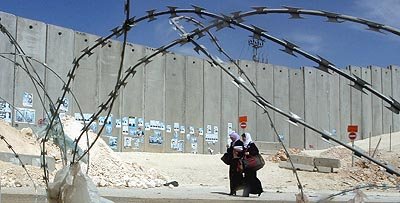
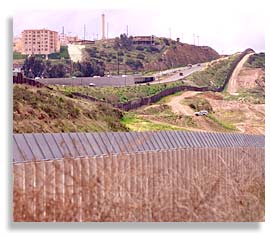
As we have prepared for our journey to the Middle East, one of our fellow travelers asked the question: "Will we able to get around?" She was concerned that she would not be able to go where she needed to go in order to talk to the people that she wanted to talk to and get done what she wanted to get done. There are real limitations on movement within the West Bank as a result of the barriers that have been constructed to separate Jews and Palestinians. I was reminded of other barriers famous and infamous, old and new that have been used to separate one group from the "other". Whether a barrier is a security fence or an apartheid wall seems to me to depend on which side of the fence
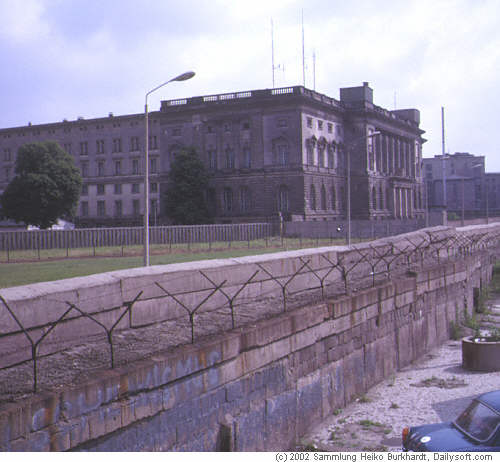 you are on and who built it. When people look at these pictures of various walls of history, they can readily identify the Warsaw Ghetto, the Berlin Wall and the barrier between Israel and the West Bank. The one that they have trouble with is the last one. This is surprising since it is the one closest to home. It is in San Diego and separates the US from Mexico. The newer barriers may look more high tech than the older ones, but they serve the same purpose. We seem to have learned very well from the Nazis and the Soviet Union. (Anything you can do, I can do better.) When fear causes us to wall the stranger, the other, the different out, we at the same time wall ourselves into our own
  ghetto. Some evolutionary biologists like E. O. Wilson would argue that this behavior is part of our genetic code, evolved over millions of years as protective defense mechanism. We are coded to identify and exclude those that are not members of our tribe as they are potential enemies who would destroy us and prevent us from surviving. This behavior is not good or bad, but is morally neutral. Others, I among them, would argue that we are created in the "image of God" and have the ability to make a moral choice based on our "God given" sense of what is right. We may, however, choose to ignore this "voice of God" and this choice certainly is affected by our cultural environment. In the US our politicians have influenced this environment by succeeding in making the term "pre 9/11 mentality" a pejorative term. George Bush accused John Kerry of having a "pre 9/11 mentality". During the Dubai Ports World controversy the Democratic Congressional Campaign Committee issued this statement: "Republicans have a pre 9/11 mentality" As we cower in fear behind our barriers and in our
  ghettos, maybe what we need is not less of a "pre 9/11 mentality" but more.
In the Gospels, the apostle known to the church as Mark, has Jesus say " whoever does not receive the kingdom of God like a little child will never enter it." When I read this passage, I am reminded of words from our now 7 year old granddaughter when she was 3 years old. As we were walking with her in Denver, she announced: "I'm Carly Liebich and everybody is my friend" Talk about a "pre 9/11 mentality". Of such is the kingdom of heaven
Wednesday, March 22, 2006
Why do we do what we do?
After considerable reflection, I have decided to become a member of the chattering class. I find that putting my thoughts down on paper (or in this case on a computer) helps me to make them more coherent. (Although after reading this some might disagree) I hope to periodically comment on issues and topics that interest me. (They may be of more interest to me than to readers) One of the problems with a blog is that sometimes you can end up between a page of chicken recipes and a porn site, but you can't always choose your neighbors.
As I prepare to leave for two weeks in Israel, Jordan and the West Bank, I am reminded that I, as well as others in our group, am venturing outside of my comfort zone. Although I have been to Jordan several times with Habitat for Humanity and have been to many other off the beaten path places, this will be my first visit to the sometime war zone that is Israel and the West Bank. Fortunately, in his sermon a couple of weeks ago about Jesus’ disciples following him to his death in Jerusalem, Father Brian reminded us all that it is OK to step outside our comfort zone, to take up our cross and to go to Jerusalem.
Needless to say, I have been keeping a close eye on what is happening in this volatile area of the world on various sources of news and information. Since Al Jareeza provides one of the most complete sources of news on the Middle East, I have been a regular reader. In this process, I came across an article which described a paper written by Stephen Walt, Professor at Harvard and John Mearsheimer of the University of Chicago on US Middle East policy. (The Israel Lobby and US Foreign Policy) They pose the question “Why has the US been willing to set aside its own security and that of many of its allies in order to advance the interests of another state?” I have asked that question in another way. Why is it in real politic interest of the US to maintain a client state in the Middle East at great cost (20% of our foreign aid budget) when this client state often operates in opposition to our national interest? It might have made sense during the cold war to counteract Soviet client states, but does it still make sense? Walt and Mearsheimer answer the question this way: “…the thrust of US policy in the region derives almost entirely from domestic politics and especially the activities of the ‘Israel Lobby’.”
I have seen no commentary on the paper it self in the US media. (at 83 pages it is not an easy read) What I have seen and heard is aggressive negative responses from a number of sources including Marvin Kalb, Lecturer at Harvard and 30 year journalist with NBC and CBS and Dennis Ross, Middle East ambassador in the first Bush and Clinton administrations as reported on Fox News. (Both of these gentlemen may have reasons to protest as they have long time relationships with AIPAC)
Today produced a negative op-ed piece in the Wall Street Journal by Ruth Wisse, Professor of Yiddish Literature at Harvard. Her answer to the question posed by Walt and Mearsheimer is “Israel fights our battles better than we fight them ourselves.” (She got this answer from a Boston taxi driver) She also provides insightful criticism of the paper as “wacko, quacko”, containing “bloopers, distortions and omissions” and an “anti-Semitic lie”.
I am reminded of a piece of advice that was given to Marcia and me early in our marriage which has contributed to our 42 years together. In a dispute “the person yelling the loudest is usually the one that is wrong” Stay tuned to see who is yelling the loudest.
Israel
Stephen Walt
John Mearsheimer
As I prepare to leave for two weeks in Israel, Jordan and the West Bank, I am reminded that I, as well as others in our group, am venturing outside of my comfort zone. Although I have been to Jordan several times with Habitat for Humanity and have been to many other off the beaten path places, this will be my first visit to the sometime war zone that is Israel and the West Bank. Fortunately, in his sermon a couple of weeks ago about Jesus’ disciples following him to his death in Jerusalem, Father Brian reminded us all that it is OK to step outside our comfort zone, to take up our cross and to go to Jerusalem.
Needless to say, I have been keeping a close eye on what is happening in this volatile area of the world on various sources of news and information. Since Al Jareeza provides one of the most complete sources of news on the Middle East, I have been a regular reader. In this process, I came across an article which described a paper written by Stephen Walt, Professor at Harvard and John Mearsheimer of the University of Chicago on US Middle East policy. (The Israel Lobby and US Foreign Policy) They pose the question “Why has the US been willing to set aside its own security and that of many of its allies in order to advance the interests of another state?” I have asked that question in another way. Why is it in real politic interest of the US to maintain a client state in the Middle East at great cost (20% of our foreign aid budget) when this client state often operates in opposition to our national interest? It might have made sense during the cold war to counteract Soviet client states, but does it still make sense? Walt and Mearsheimer answer the question this way: “…the thrust of US policy in the region derives almost entirely from domestic politics and especially the activities of the ‘Israel Lobby’.”
I have seen no commentary on the paper it self in the US media. (at 83 pages it is not an easy read) What I have seen and heard is aggressive negative responses from a number of sources including Marvin Kalb, Lecturer at Harvard and 30 year journalist with NBC and CBS and Dennis Ross, Middle East ambassador in the first Bush and Clinton administrations as reported on Fox News. (Both of these gentlemen may have reasons to protest as they have long time relationships with AIPAC)
Today produced a negative op-ed piece in the Wall Street Journal by Ruth Wisse, Professor of Yiddish Literature at Harvard. Her answer to the question posed by Walt and Mearsheimer is “Israel fights our battles better than we fight them ourselves.” (She got this answer from a Boston taxi driver) She also provides insightful criticism of the paper as “wacko, quacko”, containing “bloopers, distortions and omissions” and an “anti-Semitic lie”.
I am reminded of a piece of advice that was given to Marcia and me early in our marriage which has contributed to our 42 years together. In a dispute “the person yelling the loudest is usually the one that is wrong” Stay tuned to see who is yelling the loudest.
Israel
Stephen Walt
John Mearsheimer
Subscribe to:
Posts (Atom)